An OpenAI-compatible relay built on one-api (MIT): consumers use a single
sk-token to access the models the platform offers as usual; on top of that, this project adds a supply side — individuals can host their idle API keys as channels to join routing, earn a share of real usage, and withdraw. The key mechanisms are the routing algorithm and settlement reconciliation — they decide how the money is split, who it goes to, and whether it is split wrong.
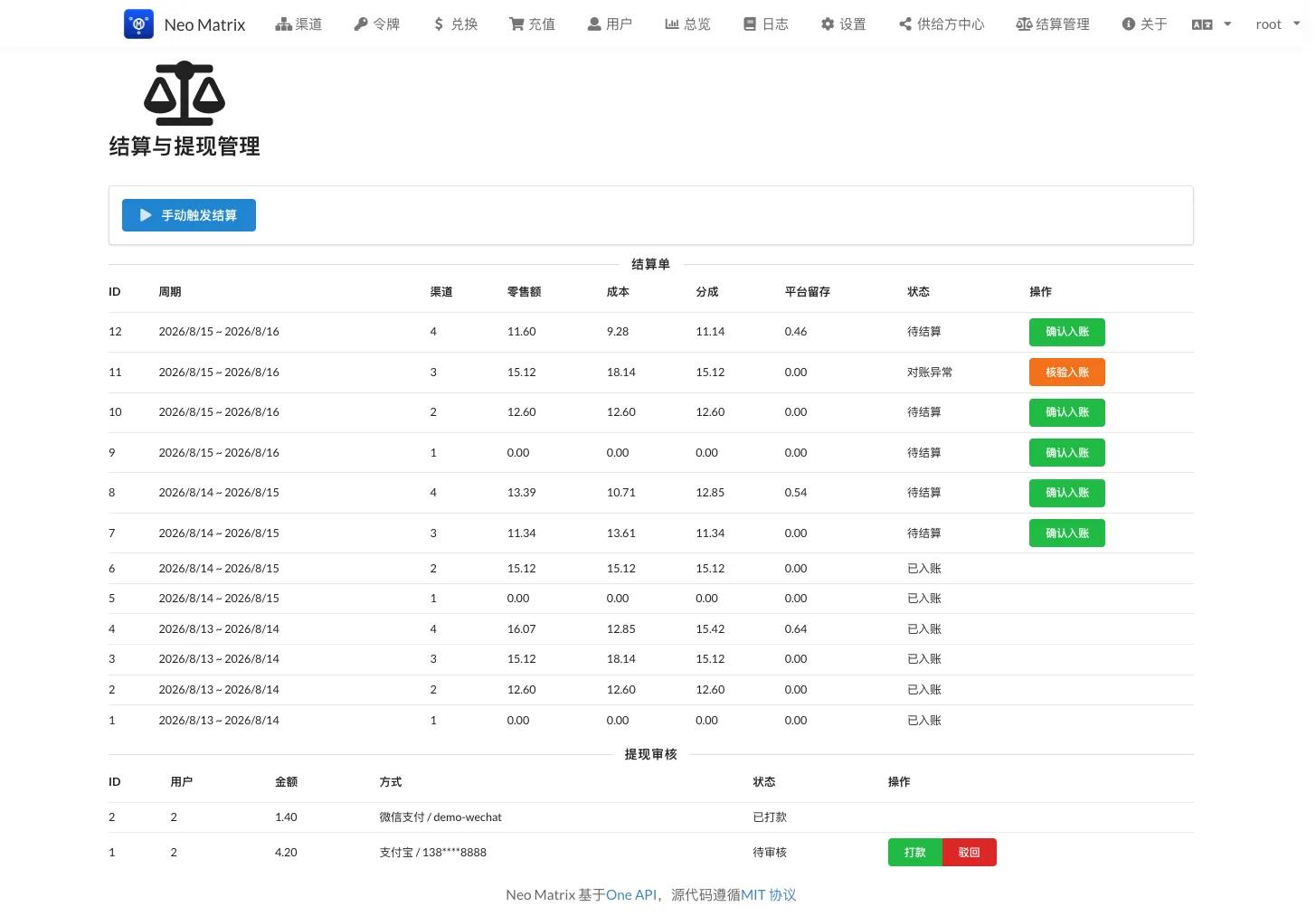
The image above is the platform admin’s settlement page: 12 settlement orders, ¥123 in flow, 6 recorded, and 1 flagged “reconciliation exception” awaiting verification. This article is about how it works — not the UI, but the routing and settlement mechanisms behind it.
First, let’s be clear: this is not “building another relay”
The consumer-side main flow fully inherits the conventional relay (one-api) design:
- The platform is an OpenAI-compatible gateway that exposes a set of model names (
gpt-4o,gpt-4o-mini,claude-*…), and consumers access it with a singlesk-token. - Behind each model is a set of channels (upstream keys) serving traffic; requests are routed to a specific channel by model —
group2model2channels[group][model], not “one channel handles all models”. - Consumer pricing is set uniformly by the platform (
ModelRatio, anchored to official public pricing) and does not vary by channel. - A token can have a model whitelist (
token.Models); requests for models not on the whitelist are rejected.
This project only adds one layer on top of that main flow — a “supply side”: individuals who hold idle keys (not just platform admins) act as suppliers, attach their keys as channels to join routing, and earn a share based on usage. This is what sets Neo Matrix apart from a typical relay.
Why personal supply sources exist
The API keys people hold are usually scattered: OpenAI, DeepSeek, Gemini, various aggregation platforms… and many people’s keys sit idle — monthly subscriptions go unused, or test keys gather dust.
Neo Matrix’s idea is simple: turn individuals’ idle keys into supply the platform can route.
- Consumers: pay by usage with a
sk-token as usual; models, pricing, and routing are transparent to them. - Suppliers: host their idle keys, earn a share of real usage, and can withdraw.
- Platform: when one model has multiple channels, automatically route through the cost-optimal channel and grow its margin.
What sets it apart from a typical relay is that the money split is transparent and auditable — how much the supplier gets and how much the platform keeps is determined precisely by the routing and settlement mechanisms, not by gut feeling.
First, tell the two keys apart
| Consumer token (issued by platform) | Upstream key (hosted by supplier) | |
|---|---|---|
| Who holds it | Consumer (sk-, generated by platform) | Supplier (OpenAI official key, etc.) |
| Who issues it | Platform /api/token | Supplier “submits API Key” |
| What it does | Calls /v1/chat/completions | Platform uses it to call upstream |
| Who can see it | Only the holder | Platform admin |
The key the consumer gets is a token issued by the platform, not any upstream key. Once a request reaches the platform, the routing algorithm decides by model which supplier’s key handles it — the consumer has no awareness of this and cannot choose which provider is used.
Architecture: two paths — routing + settlement
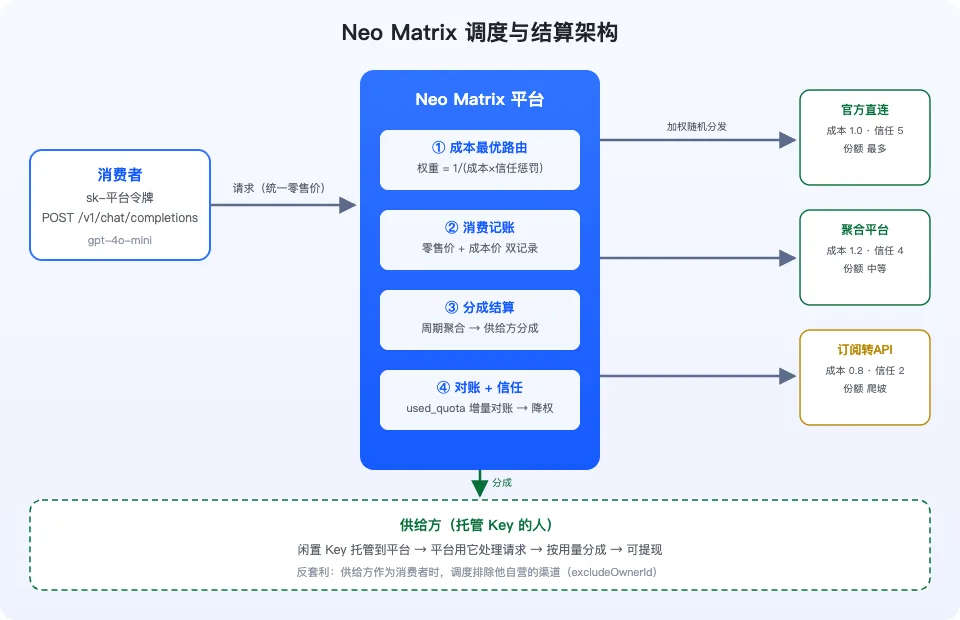
Four modules collaborate on the platform: cost-optimal routing decides which channel a request goes to; usage accounting records both retail and cost prices; revenue settlement distributes profit to suppliers by period; reconciliation + trust keeps the books trustworthy and suppresses abnormal channels.
Routing algorithm: how it differs from a typical relay
A typical relay (original one-api, etc.) routes by random selection: all available channels go into one pool and one is picked by priority-weighted random. It solves the load-balancing problem of “don’t pile all requests onto one channel,” but it does not distinguish channels by cost or trustworthiness.
Neo Matrix’s routing weaves “self-interest” into the weights. When one model has multiple channels, it neither dispatches at random nor picks only the cheapest; instead it uses a weighted random with :
- First group by priority and choose only within the highest-priority group.
- Within the group, do a weighted random with :
- Lower cost → higher score → higher selection probability (maximizing platform profit)
- Higher trust → smaller penalty (trust 5 has no penalty; trust 1 magnifies cost 5×) → higher selection probability
- Low-trust channels keep a non-zero probability — ensuring new channels can “climb the ramp”
- Anti-arbitrage guard: if the consumer happens to be the supplier of a channel, routing excludes that self-hosted channel (
excludeOwnerId), structurally eliminating “produce-and-sell-to-yourself” revenue farming.
| Dimension | Typical relay | Neo Matrix |
|---|---|---|
| Priority grouping | ✅ | ✅ |
| Random balancing | ✅ | ✅ (weighted random, low-trust keeps non-zero probability) |
| Channel cost | ❌ | ✅ |
| Channel trust | ❌ | ✅ |
| Anti-arbitrage | ❌ | ✅ excludeOwnerId |
In one sentence: a typical relay “scatters requests at random”; Neo Matrix “allocates by weighted ‘who is cheaper + who is trusted,’ while preventing produce-and-sell-to-yourself.” The former solves “can it be used”; the latter solves “how to use it most economically without being farmed.”
Trust levels: low start, automatic climb, downgrade on anomaly
Each channel has a trust level of 1–5 that determines its weight in routing. New channels default to trust 1 (cost is magnified 5×, so they only receive a small amount of “ramp-up” traffic). The up/down mechanisms:
- Automatic climb: 7 consecutive cycles of normal reconciliation → trust auto +1 (capped at 5). New channels automatically earn higher routing weight through real operation, without waiting for an admin to promote them manually. (
model/settlement.go upgradeChannelTrust) - Admin manual cap/intervention: during cost-declaration approval, a trust level (1–5) can be specified as well.
- Automatic downgrade on anomaly: 2 consecutive cycles of reconciliation anomalies → trust auto −1 (minimum 1), down only, never up. (
degradeChannelTrust)
Trust is a closed loop of “low start + automatic promotion through operation + automatic downgrade on anomaly”: new channels prove themselves by climbing, abnormal channels are suppressed by negative feedback, and admins only intervene at key points.
Using the demo data as an example: for the same gpt-4o-mini request, the official direct connection (cost 1.0, trust 5) gets the largest share; the aggregation platform (cost 1.2, trust 4) comes second; and the subscription-to-API channel (cost 0.8 but trust 2, which carries a penalty) receives a small amount of ramp-up traffic.
Settlement: how the money is split
Each charge records two numbers: the retail amount (what the consumer pays) and the cost amount (what is paid upstream). Settlement is per period:
By default the platform takes 20% of profit, and . A cost ratio of 1.0 → profit 0, supplier recovers cost; > 1.0 → the platform takes a cut of profit; < 1.0 (requires approval) → the platform subsidizes to get low-cost supply.
Three engineering challenges (pitfalls I hit)
This part is the most worth sharing from this development — every one of these was hit for real:
Pitfall 1: used_quota is cumulative during reconciliation — you can’t compare it directly.
The first version directly compared “this period’s used_quota increment” with “this period’s total log volume.” It sounds right, but used_quota is a cumulative value since the channel was created, not a per-period increment. Comparing directly never matches. The correct approach: each settlement order snapshots used_quota_end, and the increment is “current value − previous period’s snapshot.”
Pitfall 2: rerunning historical periods pollutes the reconciliation baseline.
If the background settlement loop falls behind, it backfills (re-runs periods that weren’t settled before). When the first version reran, it updated used_quota_end to the current used_quota (including later periods’ usage), which polluted the next period’s increment baseline → consecutive false “reconciliation exception” flags → channels wrongly downgraded. Fix: reruns do not update the snapshot, only the aggregate value.
Pitfall 3: concurrent double-counting of settlement orders.
Reruns + admin manual confirmation + the background loop can all run at the same time. The first version’s update branch didn’t touch the balance, so after a rerun the balance drifted from the settlement orders; after switching to “sync the balance by the difference,” it turned out two concurrent reruns would stack the difference on the same old value → double-counting. The final fix uses CAS: UPDATE ... WHERE id=? AND status!=settled AND revenue_quota=old value; if the condition doesn’t match, give up. One WHERE clause solved the funds-consistency problem.
How reconciliation exceptions are handled
A deviation exceeding the 20% threshold is judged a “reconciliation exception” → it gets flagged for admin verification (the orange “verify and record” button). Better to flag it for manual verification than to let an anomalous flow quietly get recorded. Consecutive exceptions trigger trust downgrades, forming negative feedback.
Cost bidding: inherent risks and countermeasures
cost_ratio is the cost ratio self-declared by the supplier, constrained by the platform to [1.0, MAX_COST_RATIO] (default cap 3.0). This “self-declare + locked interval” mechanism has three inherent risks against malicious pricing:
| Risk | Nature | Current countermeasure | Recommended hardening |
|---|---|---|---|
| Inflated declaration | Declares the 3.0 cap to eat platform profit | Manual approval + trust penalty | Dynamic anchoring / bill spot-audit |
| Low-price volume grab | Declares 1.0 at the floor and lowers quality to cut real cost | Lock the 1.0 floor + reconciliation downgrade | Service quality enters routing weight |
| No price discovery | Fixed interval doesn’t follow the market | Anchored to official price | Quote deviation enters weight |
Conclusion: the current approach is the conservative “self-declared cost + locked interval + trust negative feedback” scheme, which blocks most malicious quotes but is not market bidding. True price discovery (real-time anchoring, dynamic intervals, service-quality weighting) is the direction for future evolution.
UI overview
I am a consumer
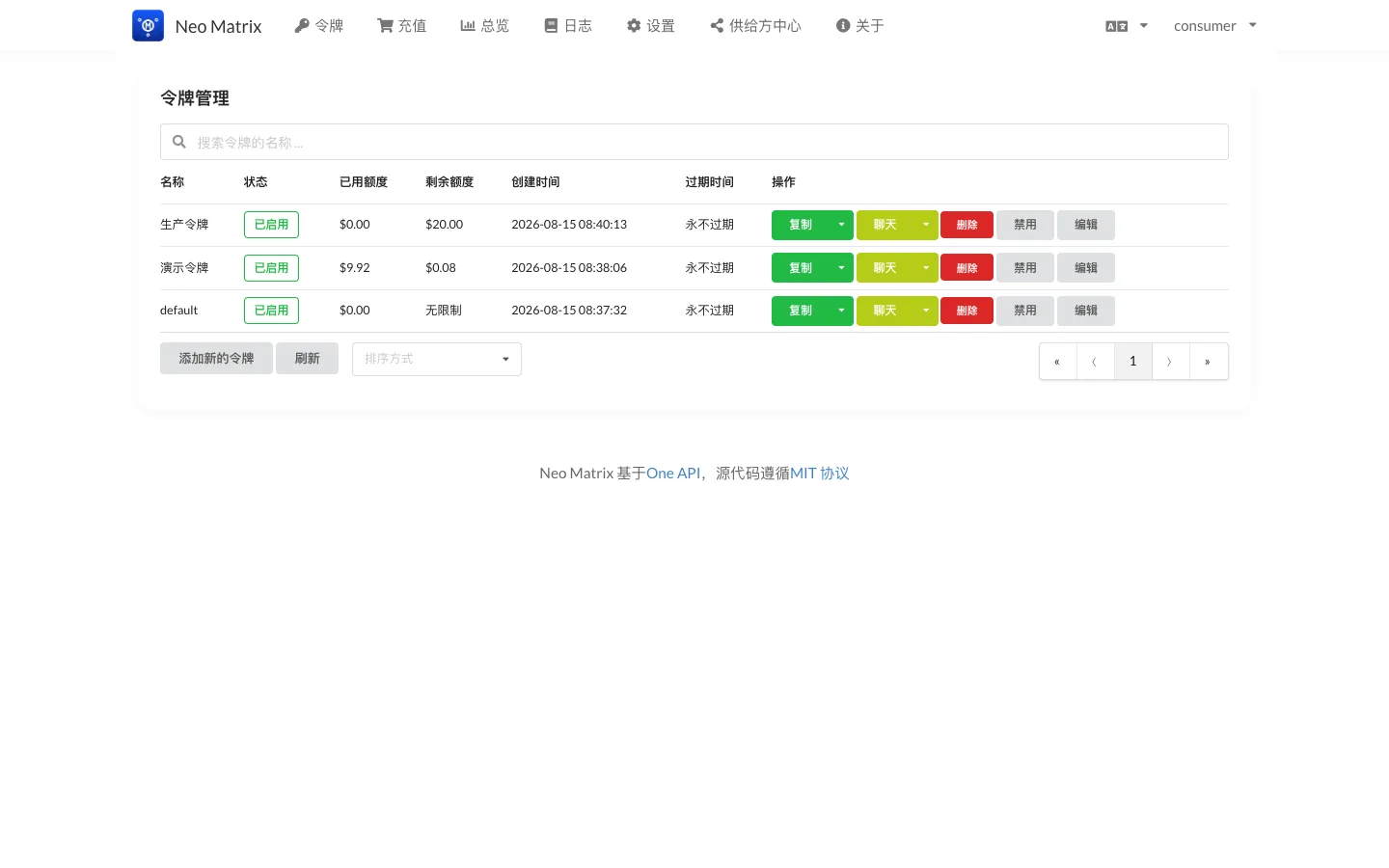
Create a token → call via the standard OpenAI interface:
curl http://localhost:3000/v1/chat/completions \
  -H "Authorization: Bearer sk-你的令牌" \
  -H "Content-Type: application/json" \
  -d '{"model":"gpt-4o-mini","messages":[{"role":"user","content":"你好"}]}'
Price = the platform’s unified retail price (ModelRatio, anchored to official public pricing). For the same model, the consumer price stays the same regardless of which channel is used:
I am a supplier
Submit an API key → the platform auto-validates it → it joins routing → earn a share by usage → withdraw:
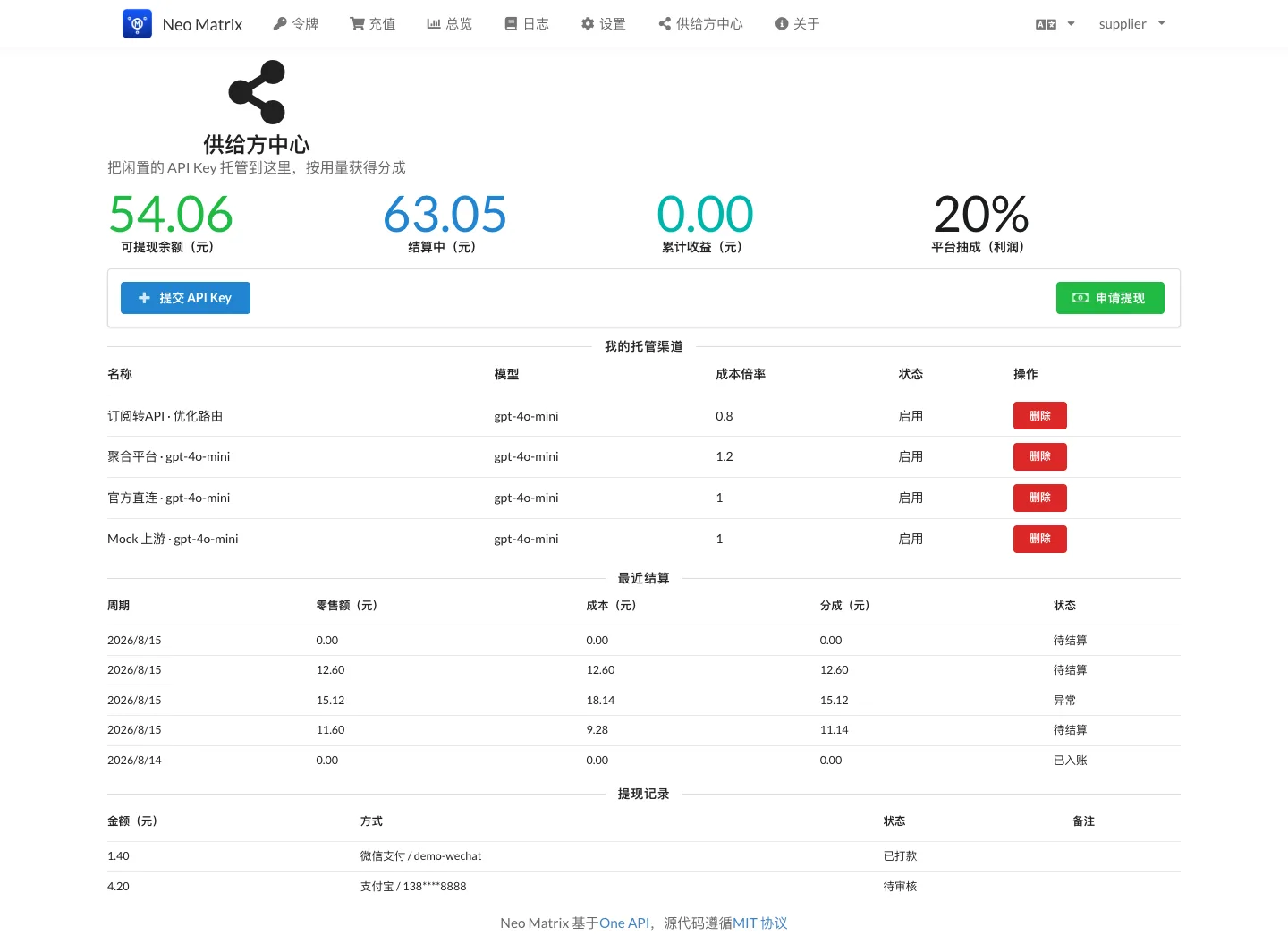
The supplier center shows the books at a glance: ¥54 withdrawable balance, ¥63 in settlement, 20% platform take.
Channel management for admins
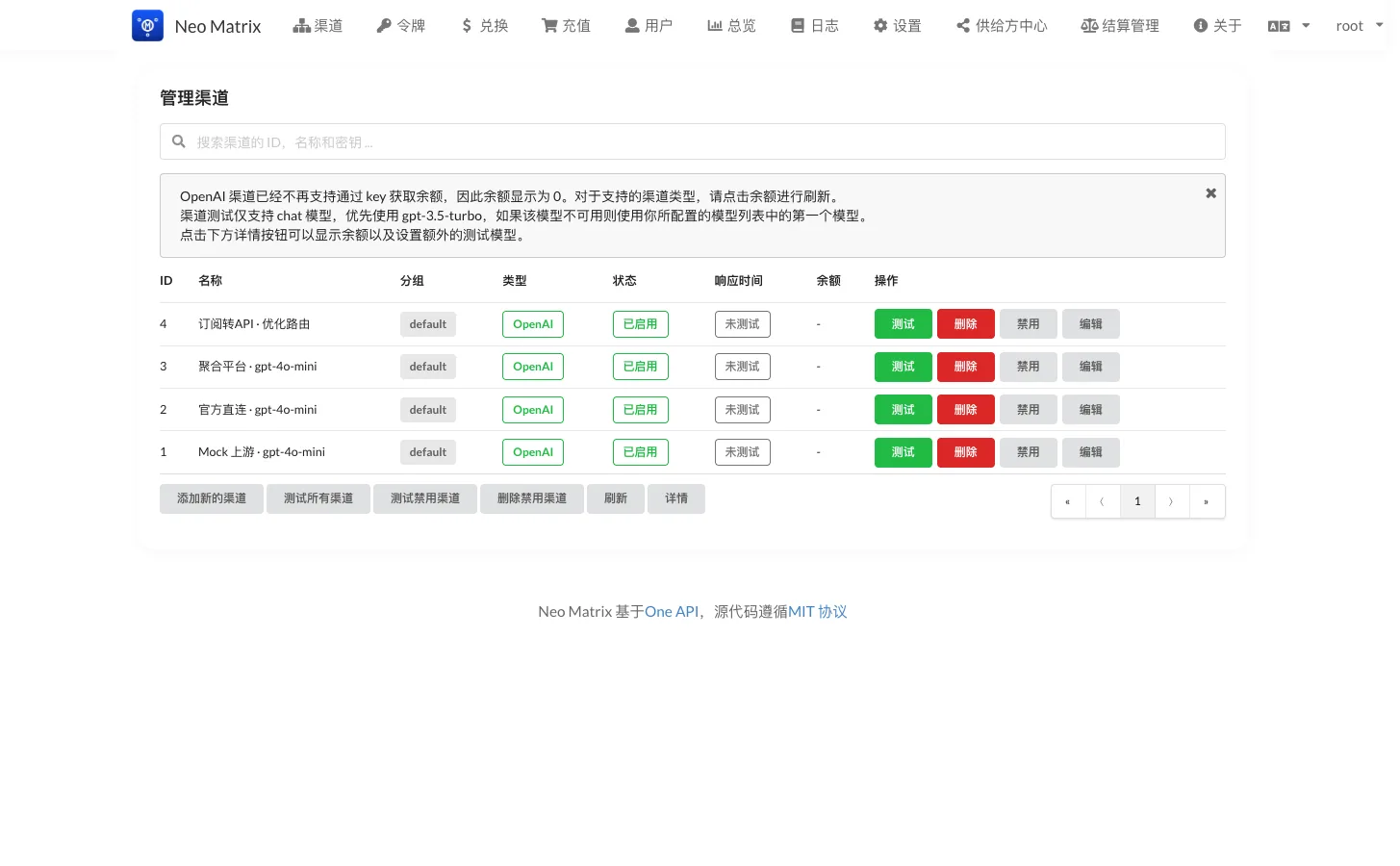
The 4 channels show different cost ratios and trust tiers. Note that “Subscription-to-API · Optimized routing” has cost 0.8 < 1.0 — anything below the official baseline must go through cost-declaration approval, to prevent “low-declare volume grabs.”
Where the demo data comes from
The screenshots above come from a real end-to-end demo: register a supplier + consumer, host 4 channels pointing to a local mock upstream, the consumer makes 120 real calls through the standard API (across 3 days), the system settles 12 orders totaling ¥123 — of which 6 are recorded, 1 is a reconciliation exception (a used_quota offset was deliberately injected to demo “verify and record”), and the supplier withdraws ¥4.2 pending review + ¥1.4 already paid. The whole flow runs real HTTP + a local mock, with no manual database edits.
A few design points worth seeing in the code
- Cost-optimal routing (
model/cache.go): within the same priority, weighted random by1/(cost × trust penalty)— low cost + high trust → higher probability, while low trust keeps a non-zero probability to climb. - Anti-arbitrage guard: a supplier’s self-operated channel is excluded from routing (
excludeOwnerId). - Trust-climb closed loop: consecutive normal periods auto +1 (capped at 5), anomalies auto −1 (minimum 1), down only, admins can intervene manually.
- Idempotent settlement:
UNIQUE(period_start, period_end, channel_id)unique index + CAS balance sync — reruns don’t double-record, concurrency doesn’t double-count. - Reconciliation snapshot:
used_quota_endis the increment baseline; reruns don’t pollute it.
Project status
| Phase | Content | Status |
|---|---|---|
| P0 | fork + module rename + branding | ✅ |
| P1 | Cost-optimal routing + usage-log cost accounting | ✅ tested |
| P2 | Supplier role + key hosting pre-validation | ✅ end-to-end verified |
| P3 | Revenue settlement + supplier dashboard (idempotent, reconciliation-exception flagging) | ✅ end-to-end verified |
| P4 | Withdrawal loop (apply / pay / reject and refund balance) | ✅ end-to-end verified |
| P5 | Subscription-to-API extension reserved | ✅ verified |